Most companies don't stop growing because of the market or competition. They stop growing because their leader never changes roles. Scale doesn't create leadership problems—it exposes them.
Hustle, control, and personal involvement create momentum in the early days of a business, but eventually, these become the very things that limit scale. The CEOs who build companies that last understand a fundamental truth:
You can't scale a business if you're still operating it like a job.
In the early days of a business, you have to be hands-on. Progress comes from direct input, but what gets you to one level won't get you to the next.
Picture this: you walk into your business, and everything's running without you. No emergencies. No bottlenecked decisions.
Can you currently take two weeks off without things falling apart? If not, you're not owning the business. You're operating it. And if you are a business operator, you are the bottleneck to your company's growth.
An operator executes. An owner designs.
An operator solves problems. An owner builds systems and has a team that minimizes the problems.
Until you shift roles, your business can't outgrow the limits of your time, energy, skills, and expertise.
Digital distractions are not going away. The leaders who rise above the competition will be the ones who learn to take control of their focus and, therefore, their time and energy.
Your ultimate goal is to build a business that doesn't need you on a day-to-day basis. That transformation doesn't start with a new strategy but with a new psychology.
Mindset first, strategy second
Most leaders overestimate the importance of tactics and underestimate the power of their own psychology.
Strategy matters, but psychology determines whether strategy is executed under pressure.
Fear is the invisible force that limits scale. Fear of losing control. Fear of hiring the wrong person. Fear of chaos during growth. It shows up as "caution," but what it really does is stall momentum.
Scalable CEOs don't eliminate fear. They train themselves to respond to it differently.
They manage their emotional state intentionally. They interpret uncertainty as opportunity rather than threat. They understand that pressure is feedback, not failure.
Every business will face adversity. The difference between companies that thrive and companies that collapse is the leader's psychology.
Great leaders see challenges as opportunities and problems as something to be solved. They tackle challenges with clarity and vision. When they do that, decisions improve, teams stabilize, confidence grows, and momentum returns.
What’s the unique ability that sets you apart as a leader?
Scalable companies are built around a vision that extends beyond personal gain. Your team will act when they know why they should do something. A purpose provides a shared vision for decision-making and behavior. Employees who believe they are contributing to something meaningful will take initiative, solve problems, and take ownership of their work.
This extends beyond internal teams to customers as well. When customers buy into your vision, they become raving fans. Fans stay longer than customers. They spend more and willingly promote the brand to others.
Starbucks is one of the clearest examples of getting emotional buy-in from customers.
Howard Schultz didn't just build a coffee company. He created a place between home and work—a space for connection, comfort, and community. That vision turned Starbucks customers into evangelists. Loyalty wasn't about caffeine. It was about belonging and identity.
Patagonia did the same. By building around a shared mission—environmental responsibility—their customers became ambassadors. In order to show a deep commitment to the environment, Patagonia told customers not to buy unless they really needed something. As a result, trust grew. And trust drives scale.
The most scalable companies aren't asking, How do we get more customers? They're asking, How do we get customers to share in our why?
Simplify relentlessly
Scale and complexity often grow together unless leaders intervene. And, as Tony Robbins says, "Complexity is the enemy of execution."
As businesses expand, offerings multiply, metrics increase, and decision paths become cluttered. Without discipline, the complexity that comes with growth will hold your company back.
When Steve Jobs returned to Apple in 1997, the company wasn't failing from a lack of ideas. It was suffocating under complexity. His first move wasn't innovation. It was elimination. By slashing a bloated product lineup down to a simple, focused core, Apple restored clarity. That discipline of subtraction became one of Apple's greatest growth advantages.
Scalable CEOs prioritize relentlessly. They identify the few vital moves that drive results and eliminate the rest.
Simplicity reduces friction. It creates clarity for teams and frees up energy for what matters most.
Tony's business strategy series unlocks that 7 key factors that will make or break your business
Hustle is not a long-term strategy. Heroics don't scale. You can't outrun complexity with more hours.
Scalable companies are built by leaders who focus on creating systems that turn vision into consistent execution.
These systems include:
A hiring process that attracts and develops leaders
Decision-making frameworks that create clarity
High standards for customer experience
Feedback loops to help the company fall in love with its customers
Ray Kroc didn't scale McDonald's by relying on exceptional talent. He scaled it by creating systems that produced predictable outcomes—regardless of who was on shift. Consistency became the competitive advantage.
Systems don't replace people: they empower them. When structure is clear, teams can operate with autonomy and confidence. The leader's role shifts from problem-solver to steward of the system.
That's how the machine runs, and that's how the business grows without you.
To scale the business, scale the leader
Scalability isn't about doing more. It's about letting go.
Letting go of control. Letting go of the need to be involved in everything. Letting go of the identity that created early success but now limits future growth.
The real work of scale happens internally first.
Ask yourself:
Where am I still operating instead of owning?
What fear is shaping my decisions right now?
What would change if I trusted my team's efforts more than my own?
If you want to unlock the next level, you need to step out of the day-to-day and see your business from a higher vantage point.
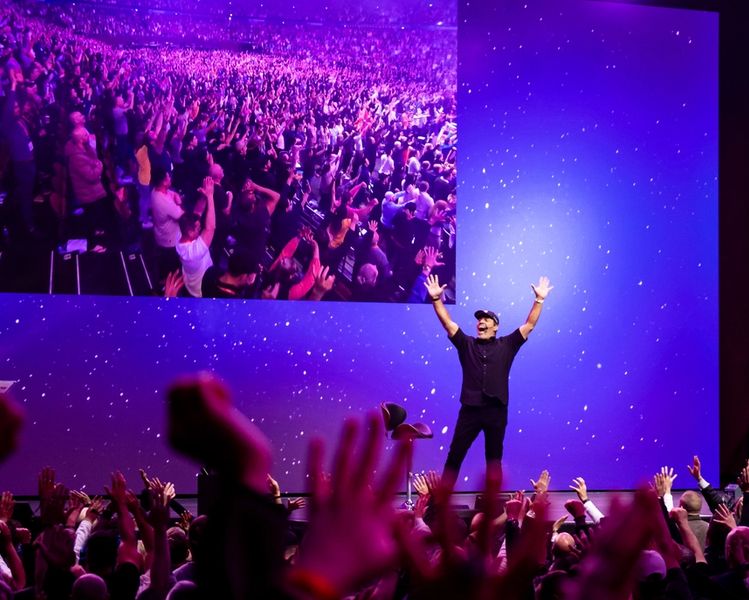
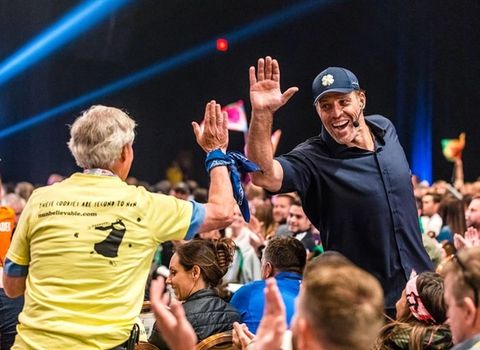
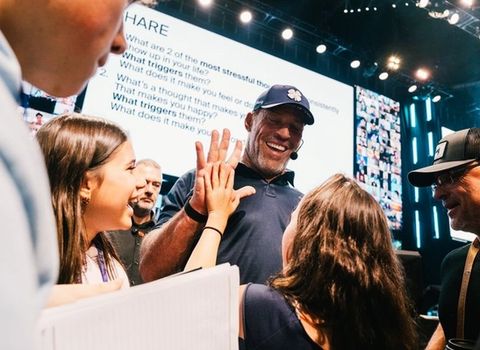
A business growth event is designed to do exactly that. These events give you the tools and drive to shift your mindset and build systems that scale without burning you out. You'll learn what you can let go of, how to manage your emotional state, and how to implement systems so your business can grow without you.
Businesses that scale the most aren't built by leaders who grind harder. They're built by leaders who evolve faster.
Video
Ignite explosive business growth at Tony's Business Mastery event
Companies often stall in growth—not because of the market or competition, but because their leaders fail to evolve. Effective business transformation coaches understand that true scalability begins when a leader shifts from operator to owner. Explore this infographic for key insights CEOs can use to scale with confidence.
Inside the mindset of CEOs who scale | Tony Robbins